Top 10 Types of Cryogenic Ball Valves for Global Buyers

Global LNG trade reached 401.4 million tonnes in 2023, up 2.1% from 2022, according to GIIGNL’s 2024 Annual Report. The IEA’s Gas 2024 report also describes substantial LNG supply capacity growth through 2030. These shifts make dependable equipment selection increasingly important. For LNG service near -162°C, temperature changes can affect materials, clearances, seals, and maintenance access. Cold is unforgiving.

This guide examines ten types of cryogenic ball valves, including floating and trunnion-mounted designs, top-entry and side-entry bodies, and full-port and reduced-port options. Each arrangement brings different trade-offs in operating torque, installation, inspection, and shutoff performance. A valve that suits a compact transfer line may not be the right choice for a high-pressure storage or process application. Details matter: consider the specified temperature range, pressure rating, seat and body materials, stem design, and documented test requirements.

The categories provide a practical starting point for comparing suppliers and specifications, not a universal ranking. Product descriptions can use similar terms for different construction details, so buyers should verify drawings and test records. No overview can replace project-specific engineering review. That caveat matters.
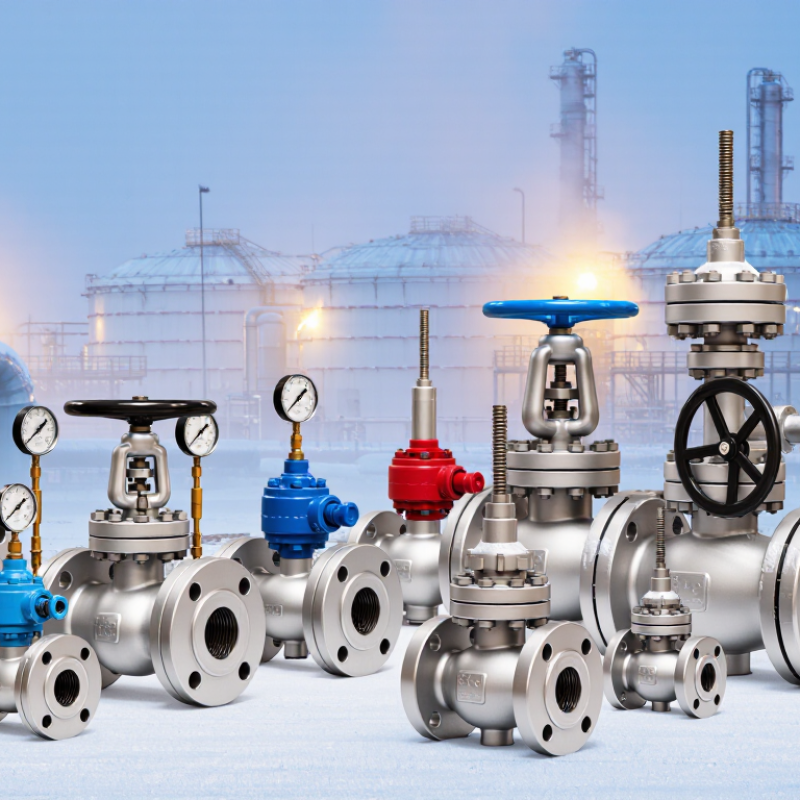
Top 10 Types of Cryogenic Ball Valves for Global Buyers

Cryogenic Ball Valve Basics: Service Below −150°C and LNG at −162°C

Top 10 Types of Cryogenic Ball Valves for Global Buyers

Cryogenic service generally means operation below −150°C. LNG is commonly stored near atmospheric pressure at about −162°C, where ordinary valve assumptions can fail. Steel contracts, seals stiffen, and tiny clearances matter. Cold changes everything.

An extended bonnet helps keep the stem packing farther from the cold zone, while suitable materials and low-temperature testing help maintain sealing performance. Trapped liquid in a valve cavity also deserves attention: warming can raise pressure, so cavity relief arrangements must match the system design.

The scale is substantial.

GIIGNL’s Annual Report 2024 recorded 401.4 million tonnes of global LNG trade in 2023.

That figure does not make every LNG valve alike. Buyers should check the specified temperature, pressure class, end connections, leakage criteria, and whether testing reflects actual cryogenic conditions. ISO 28921-1 covers design, manufacturing, and testing requirements for low-temperature isolation valves.

Still, a standard or product label alone cannot confirm suitability for every operating cycle. Ask for documented test conditions and inspect how the bonnet, stem seal, and seat materials perform together. One overlooked detail can matter.

And honestly, field maintenance access is sometimes treated as an afterthought, even though cold gloves and tight spaces make it harder.

Classification Framework: Ten Designs by Ball Support, Bore, and Entry

Cryogenic ball valves are best compared across three independent axes: ball support, bore, and entry design. Floating-ball valves rely on the ball moving against the downstream seat; trunnion-mounted valves use supports to limit movement. Both are available with full or reduced bores. Top-entry, side-entry, and end-entry describe assembly access, not ball support. This distinction matters: one valve may be trunnion-mounted, full-bore, and top-entry at once. The labels overlap.

These choices affect more than flow. A full bore can reduce restriction and ease line cleaning, while a reduced bore may suit tighter space or cost constraints. Top-entry construction can simplify in-line maintenance, but access clearance is still needed. GIIGNL’s Annual Report 2024 records 401.4 million tonnes of global LNG trade in 2023, underscoring the scale of cold-service infrastructure—not a measure of valve demand. For cryogenic duty, verify the specified temperature, materials, extended bonnet, seat leakage criteria, and applicable testing, such as ISO 28921-1. The taxonomy helps, but it is not a substitute for reviewing the actual datasheet.

Tips: Ask suppliers to state all three axes separately. Check dimensions and maintenance access against the installed piping. A familiar label is not enough.

Core Types: Floating, Trunnion-Mounted, Full-Bore, and Reduced-Bore Valves

GIIGNL reported 401.4 million tonnes of global LNG trade in 2023, up 2.1% year over year (2024 Annual Report). For buyers, that scale makes cryogenic valve selection a practical reliability decision, not just a catalog comparison. Operating temperature, pressure, pipe layout, and maintenance access all matter.

In floating ball valves, the ball moves slightly against the seats to maintain sealing; this design can suit many general services. Trunnion-mounted valves support the ball with upper and lower pivots, often reducing operating torque in larger or higher-pressure duties. Full-bore valves have an opening close to the pipe’s internal diameter, helping limit flow restriction and support pig passage. Reduced-bore models are typically more compact, but their narrower passage can increase pressure loss. There is no universal winner. ISO 28921-1:2013 provides design and testing requirements for low-temperature isolating valves, but buyers still need to check the actual service conditions.

Tips: Confirm the specified minimum temperature, end connections, and seat materials. Ask how the bonnet extension protects the stem packing from the cold zone. A datasheet can look complete, yet installation details are easy to overlook.

Top 10 Types of Cryogenic Ball Valves for Global Buyers — Core Types: Floating, Trunnion-Mounted, Full-Bore, and Reduced-Bore Valves
Valve Type Construction and Flow Path Typical Cryogenic Use Key Buyer Checks
1. Floating, Full-Bore The ball is held between the seats and can move slightly under pressure. The port is approximately the same diameter as the connected pipe’s nominal bore. Isolation in smaller or moderate-size lines where a relatively unrestricted flow path is useful. Confirm pressure rating, seat design, operating torque, and cryogenic test conditions for the specified size.
2. Floating, Reduced-Bore Uses a floating ball with a port smaller than the adjoining pipe’s nominal bore, creating a reduced flow area. Applications where a compact valve or lower initial cost is preferred and some flow restriction is acceptable. Check pressure drop, flow capacity, and whether the reduced port meets the process and cleaning requirements.
3. Trunnion-Mounted, Full-Bore The ball is supported by trunnions, while seats move or are energized toward the ball. The port is approximately pipe-bore size. Larger-diameter or higher-pressure isolation duties where ball support and manageable operating torque are important. Review seat sealing direction, cavity-pressure management, actuator torque, and the manufacturer’s cryogenic qualification.
4. Trunnion-Mounted, Reduced-Bore Combines trunnion ball support with a port smaller than the adjoining pipe’s nominal bore. Pipeline and process isolation where a trunnion design is required but a full-bore passage is unnecessary. Compare pressure drop and flow capacity with the full-bore option; verify end connections and pressure class.
5. Top-Entry Ball Valve The internal components are accessed through a removable top closure. Top-entry describes body access, not whether the ball is floating or trunnion-mounted. Installations where in-line inspection or maintenance access is a design priority. Confirm maintenance clearances, pressure-boundary design, insulation access, and whether servicing can be performed in the installed position.
6. Side-Entry Ball Valve The body is assembled from side-loaded components and typically joined using bolted body sections. It may be floating or trunnion-mounted. Common process and pipeline arrangements where a conventional body layout suits the installation. Check body-joint design, external leakage requirements, installation orientation, and access for maintenance.
7. Two-Piece Body Ball Valve The pressure-containing body is assembled from two principal sections. The design may be full-bore or reduced-bore and floating or trunnion-mounted. General cryogenic isolation where the two-piece body arrangement meets the specified service and maintenance needs. Verify body-joint integrity, end connection type, rated temperature range, and documented low-temperature testing.
8. Three-Piece Body Ball Valve A central body section is held between two end pieces, often allowing the body section to be removed for service. Design details vary by model. Smaller process lines where maintainability and component access are useful. Check whether the valve can be serviced without removing the end connections and confirm that the assembly is qualified for the required temperature.
9. Multiport Ball Valve A specially ported ball connects different flow paths, such as L-port or T-port arrangements. Porting and available flow positions depend on the design. Flow selection or diversion where multiple line connections are needed in one valve body. Review the port diagram, permitted switching positions, sealing behavior in each position, and actuator operating sequence.
10. Extended-Stem Cryogenic Ball Valve An extended stem or bonnet separates the stem sealing area from the cold valve body. It can be combined with different bore, body, and ball-support designs. Cryogenic service where stem packing needs thermal separation from the cold process fluid. Specify extension length and installation orientation; check insulation limits, packing arrangement, and the required cryogenic test procedure.

Note: These categories describe different design features and can overlap. Confirm the complete valve specification, including materials, pressure-temperature rating, seat and stem sealing, end connections, and cryogenic test documentation, for the intended service.

Specialized Types: Top-Entry, Side-Entry, Three-Way, Jacketed, Extended-Stem, and DBB

Top-entry cryogenic ball valves allow technicians to inspect or service internal parts through a removable top cover. This can simplify maintenance in a crowded pipe rack. The line still needs safe isolation and depressurization before work begins. Side-entry valves often use a split-body construction, which can suit familiar workshop repair practices. Access depends on the installed layout. Small clearances can make either design awkward.

Three-way valves direct flow between process lines, or combine streams, depending on their port arrangement. Check the flow diagram carefully; port patterns are not interchangeable. Jacketed valves add an outer chamber for temperature control around the body. They may help manage heat transfer or prevent unwanted temperature changes, but the jacket’s duty must match the process. Details matter.

Extended-stem valves position the packing and operating components farther from the cold zone. This helps limit exposure to cryogenic temperatures, while stem length must still fit the insulation and actuator layout. Double-block-and-bleed valves provide two sealing barriers with a bleed point between them. That arrangement supports isolation checks, but it does not replace sound operating procedures. Drawings sometimes leave cavity details unclear. Ask for confirmation before specifying the valve.

Global Qualification: BS 6364 Cryogenic Testing at −196°C and ISO 28921-1

Cryogenic ball valves need evidence beyond a low-temperature label. BS 6364 provides a framework for testing valves under cryogenic conditions, including testing at −196°C. ISO 28921-1 addresses design, manufacture, and production testing of isolation valves for low-temperature service. These standards support different parts of qualification; one test certificate should not be treated as proof of every operating condition. That distinction matters.

The International Gas Union’s World LNG Report 2024 records global LNG trade of about 401 million tonnes in 2023. This scale makes dependable isolation equipment important across terminals, storage, and transfer lines. For buyers comparing valve types, request the test temperature, hold time, leakage result, and test medium. Check whether the tested assembly matches the offered design, including seat materials and stem sealing. A −196°C result is useful, but it does not automatically establish performance at every pressure or cycle count.

Tips: Ask suppliers for traceable test records against BS 6364 and the relevant ISO 28921-1 requirements. Confirm the intended fluid and pressure range in writing. Look closely at seat leakage after cooldown and warm-up; a cold test alone may miss issues during temperature changes. Keep some doubt. Standards guide evaluation, but installation details and operating cycles still matter.

Top 10 Types of Cryogenic Ball Valves for Global Buyers

Global qualification reference: BS 6364 cryogenic testing at −196°C and ISO 28921-1.

Normal boiling points at 1 atm provide a reference for the temperatures cryogenic valves may encounter. Nitrogen boils at approximately −195.8°C, close to the −196°C test reference. These fluid properties do not establish a valve’s qualified operating limit; confirm the applicable standard edition, test procedure, materials and product-specific results.

Source: NIST Chemistry WebBook; values rounded.